|
Copyright Notice
Liability Disclaimer:
I am not a veterinarian, and do not wish
for you to use this information to diagnose a problem. Instead, it
is offered as "food for thought" for responsible and educated dog
owners.
Photo Wanted: If you
have a photo to share (you must own the photo, so we are not breaking copyright
rules) that we may put on this page to educate people, please e-mail us. We
would love a photo with an injury caused by a dew claw.
Dew Claws
Most good beagle breeders have their
puppies' dew claws removed when the puppies are very young. At this time,
the dew claw is only held on by a thin flap of skin, and it does not have
a bone attachment. While some
beagle breeders remove puppy dew claws themselves, we take our puppies to
our veterinarian for the removal.
As a potential buyer, this is a question we feel you should ask anyone
that you are considering buying a puppy from. Removal of the claws for
young puppies is a simple procedure that causes very little discomfort
(because it is just held on by a thin piece of skin).
Some puppies don't even make a noise, and a couple seconds after the removal, they
act as though they don't feel a thing. Some puppies don't even wake up
when it is snipped off!
Removal of dew claws later, when
puppies are larger or even full grown, is a MUCH more painful procedure.
The best time to remove dew claws is when puppies are just a few days old
because they are only held on by a little bit of skin.
What Are Dew Claws?
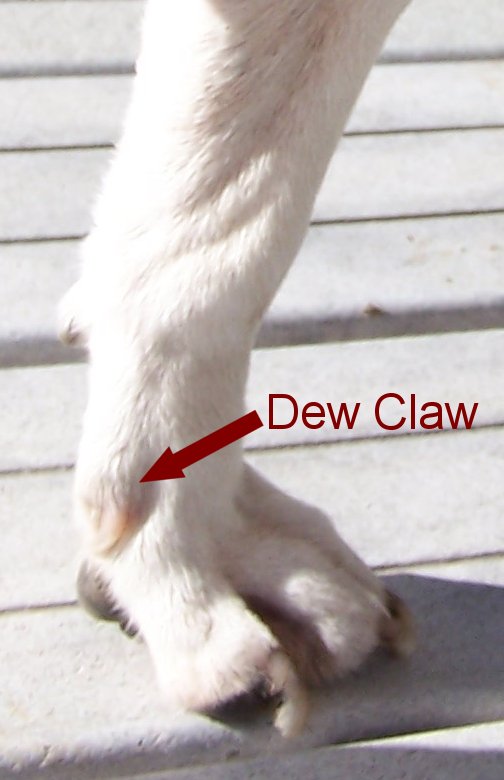
Dew claws are thumb-like claws located on the inside of the leg above
the foot. In beagles, they are often only present on the front legs,
although some bloodlines of beagles do have them on all four legs. The dew
claws on the back legs are sometimes larger (sometimes HUGE) and
could be more prone to injury than
small ones on the front legs.
In some breeds of dogs in certain countries and registry associations,
dew claws are required to remain present in order for the dog to be shown
or to compete in performance classes. For beagles in the United States,
dew claws are not advantageous for the dog to have, and in fact can cause
injury to the dog if left intact.
When puppies are very young, the dew claws are not attached to the leg
by bone, so are just held on by skin. Dew claws do not touch the ground
when puppies/dogs stand or walk, but can touch the ground on some dogs
when they run.
What Are the Advantages of Removing Dew
Claws?
- First Veterinary Visit. It gives the veterinarian an
opportunity to see each puppy shortly after birth.
- Injury Prevention from Over Growth. Since dew claws don't
touch the ground, they don't wear off. Therefore, the claw may grow to
become very long, and can curl around and injure the leg if not kept
trimmed.
- Injury Prevention from the Environment. Removing dew claws
also prevents the claw from becoming caught in carpet or grass/weeds and
tearing, causing a painful injury that might require veterinary
care...and cost to the owner...down the road. Photos of injured dew
claws:
Google Images of injured dew claws
- Prevent injury to owners...dew claws can be really
sharp, and they often scratch/cut owners' skin!
- At birth or in the first few days, it takes about 2 seconds
per claw!
Video (note that our veterinarian removes our dew claws, while this
video is an owner doing his)
Another video
What are the Disadvantages of Removing Dew
Claws?
Some people feel the dew claws are necessary for dogs
to hold bones to tear off meat. Others feel they perform a function when
dogs run, touching the ground while up to speed. Tree-climbing hunting
breeds might use the dew claw to climb trees! Others feel nothing should
be altered from the way nature intended (though on that note, in the
human world, I have to say I'm glad I have straight teeth due to braces,
and that my wisdom teeth were removed!). However, spaying and neutering
alters dogs but also offer great advantages, so.... ;-)
I'm still researching reasons to leave dew claws on
dogs.
Why Do Some Beagle Breeders Not Remove Dew
Claws?
- To save money. Some people do not wish to add to the cost of
raising puppies with this veterinary visit.
- They have not witnessed injury caused by dew claws. If they
haven't seen an injury, they think it can never happen. Or, possibly
they have not educated themselves and so don't even know injuries are
sometimes caused by dew claws not being removed.
- Fear that it hurts the puppy (which in reality, is only a few
seconds of sensation, as puppies seem to only react for about 3 seconds,
and some don't react at all).
With that said, please be reminded that we DO have our
puppies' dew claws removed. We feel it is well worth the few dollars
it takes for the prevention of later injury and infection this simple
procedure provides.
In other words,
we
pay for it NOW so you and your dog don't pay LATER.
If you buy a puppy that has not had its dew claws removed, be aware
that you might have a veterinary bill in the future to treat an injury. In
addition, consider the fact that if the breeder of that puppy cut corners
to save money by leaving the dew claws, he/she may have cut other
corners as well and that your puppy may be missing important health-care
procedures that the puppy should have received!
What if you don't want your puppy's dew claws
removed?
If you reserve your puppy before we have had
dew claws removed, and you want them left on, we will leave FRONT dew
claws on for you with conditions as follows (we won't leave
back dew claws on unless they are tiny, and the vet feels they won't
stick out any more than the front ones).
-
You must have reserved a puppy and paid your
deposit before the litter's first vet appointment.
-
If you later back out, we will not refund the
amount of our standard deposit for that puppy ($100 in 2018).
The reason for this is that if you later decide to not
get your puppy, it will be too late for us to remove the dew claws.
The family that does adopt that puppy will have a puppy with dew claws.
They may forget, over time, that the dew claws are still on because the
original person reserving the puppy demanded that we leave them on.
They may be asked by friends/family/veterinarian why their puppy has
these claws, and their friends/family/veterinarian may say,
"Well, that breeder was too cheap to remove dew claws. I wouldn't buy
from them again."
We really would prefer to not be at risk of being accused of being "too
cheap" to remove dew claws.
Caring for Injured Dew Claws
https://authoritydog.com/dogs-dew-claw-injury-take-care/
https://smartdogowners.com/dew-claw-injuries/
 |