|
Congratulations!
Before you take your
puppy home, this page might help you prepare for those first few days and
weeks of working with your puppy and understanding his behavior.
Puppy Development
Birth to Two Weeks: Neonatal Period
Two to Four Weeks:
Transitional Period
-
Puppy is most influenced by his mother and
littermates.
-
Eyes open, teeth begin to come in, and senses
of hearing and smell develop.
-
Puppy begins to stand, walk a little, wag tail,
and bark.
-
By the fourth or fifth week, eyesight is
becoming well-developed.
Three to Twelve Weeks:
Socialization Period
-
During this period, puppy needs opportunities
to meet other dogs and people, but KEEP IT SAFE...puppies don't have
full immunity to diseases/viruses until a few weeks after receiving their
last puppy vaccination (so keep them away from areas frequented by
lots of dogs until around 5 months old).
-
By three to five weeks, puppy becomes aware of
his surroundings, companions (both canine and human), and relationships,
including play.
-
By four to six weeks, puppy is most influenced
by littermates and is learning about being a dog.
-
From four to seven weeks:
Don’t discipline for
play fighting, housebreaking mistakes or mouthing – that’s all normal behavior
for a puppy at this stage.
-
From four to twelve weeks, puppy remains
influenced by littermates and is also influenced by people. Puppy learns to
play, develops social skills, learns the inhibited bite, explores social
structure/ranking, and improves physical coordination.
-
By five to seven weeks, puppy develops
curiosity and explores new experiences. Puppy needs positive "people"
experiences during this time.
The following occur around the time puppies leave us,
or after puppies leave us:
-
By seven to nine weeks, puppy is refining his
physical skills and coordination, and can begin to be housetrained. Puppy has
full use of senses.
-
By eight to ten weeks, puppy experiences real
fear involving normal objects and experiences; puppy needs positive training
during this time. “I’m
Afraid of Everything” Stage--Not all dogs experience this, but most do, and
they’ll appear terrified over things that they took in stride before. This is
not a good time to engage in harsh discipline (not that you ever should
anyway!), loud voices or traumatic events. Keep your voice upbeat when
puppy seems scared.
-
Your puppy’s bladder and bowels are starting to come under much
better control, and he’s capable of sleeping through the night sometime
between 8 and 12 weeks.
-
By nine to twelve weeks, puppy is refining
reactions, developing social skills with other dogs (appropriate
interactions), and exploring the environment and objects. Puppy begins to
focus on people; this is a good time to begin training.
You can
begin teaching simple commands like: come, sit, stay, down, etc. Leash
training can begin.
Three to Six Months: Ranking Period
-
Puppy is most influenced by "playmates," which
may now include those of other species.
-
Puppy begins to see and use ranking (dominance
and submission) within the household (the puppy's "pack"), including humans.
-
Puppy begins teething (and associated chewing).
-
At four months of age, puppy experiences
another fear stage.
Keep your voice upbeat when puppy seems scared.
Six to Eighteen Months:
Adolescence
-
Puppy is most influenced by human and dog
"pack" members.
-
At seven to nine months, puppy goes through a
second chewing phase, part of exploring territory.
-
Puppy increases exploration of dominance,
including challenging humans.
-
If not spayed or neutered, puppy experiences
beginnings of sexual behavior.
Links of Interest
Puppy Development and the First Days/Weeks at Home
Training Links
Potty/House Training
General Training
Biting and Dominance
Crate Training
Chewing
Shows and Grooming
Top
Potty Training (Housetraining)
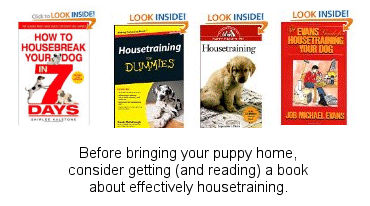
The potty training is the toughest thing for me, also. So much of it is
"timing," so we start by taking the puppy outside as soon as he/she wakes up
from a nap, and also within 20 minutes of eating if he hasn't shown signs of
wanting to go after eating.
We can usually tell if a puppy has to (I guess I have to say this
word...unavoidable, LOL!) poop. ;-) When they need to go, their bottom/anus
will be puffing out a little bit. If it isn't puffing out, "usually," they
aren't close enough to needing to potty to be able to get them to go at this
age. You'll quickly learn to recognize that physical sign, and also his
signs of looking for a place to go.
We like to take them to the door, set them on the floor, and either tap
their paw on the door or ring a bell (hanging from a string or a bell that
is suctioned to the floor) before proceeding outside. This teaches them that
they need to "give a sign" at the door to signify that they need to go
outside. If we pick them up and carry outside, without stopping and asking
them to make a signal, it may take longer to get them to give us a sign.
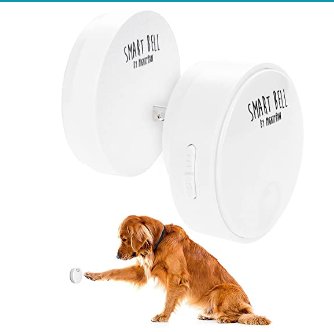
Dog potty bells on Amazon
Dog potty bells on
Chewy
(Don't get the paw-shaped one...the round/square/rectangles are much
easier for puppies to use)
General Training
3 0 Days to Puppy
Perfection, online course:
30 Days to Puppy Perfection - How to Train A Dream Dog
All Training Topics...very nice site!
http://www.canismajor.com/dog/ttrain.html
Puppy Training Tips
http://www.perfectpaws.com/pup17.html
Puppy Training Rules
http://www.peteducation.com/article.cfm?cls=2&cat=1549&articleid=173
Miscellaneous tips
http://p4.hostingprod.com/@quietwinterfarm.org/House_breaking_101.html
Video clips for common
"tricks"
http://www.ehow.com/videos-on_1381_train-beagle.html
Commands/Vocabulary/Common
Words used for training
Online/Remote Training Classes can be REALLY
HELPFUL! Search online for "online puppy training class" or similar
key words.
Here are some example results...I have not taken all of these
courses, so am not indicating that they are tested by me/us.
I'm just sharing some search results with you.
Puppy Starter Classes https://www.howtotrainadreamdog.com/puppy-training-classes/
https://www.akc.org/expert-advice/training/online-training-a-new-resource-for-dog-owners/
(info, and a few links to training)
https://www.thesprucepets.com/best-online-dog-training-courses-5075564
https://www.howtotrainadreamdog.com/ Online training (MANY
FREE VIDEOS), YouTube
videos, Zoom meeting options (free and also paid-for training)
https://www.petco.com/shop/en/petcostore/c/online-dog-training-courses
https://spiritdogtraining.com/online-dog-training/
Zak George's Dog Training Revolution, New Puppy Channel:
Zak's Puppy Youtube Channel/Video List
Kikopup Youtube Channel:
Dog
Training by Kikopup - YouTube
Some of the above are FREE.
Paid online training courses
are probably even better, though.
The free online "courses" typically tell you "what to teach them to do," but
not always HOW to teach them those things.
Through searching and reading lots of blogs and watching
lots of videos, you CAN piece together those teaching tips. Or, you can pay
for a course, and find out HOW to train a lot more easily than piecing it
together by yourself. Examples:
30 Days to Puppy Perfection
https://www.howtotrainadreamdog.com/puppy-perfection-course/
https://www.puppytrainedright.com/site/home
Biting and Dominance
Puppies need structure and rules. Without structure and rules, they feel lost
and out of control. They may then act in ways that seem like they are going to
be "bad dogs." But, structure and showing puppies what is and isn't appropriate
behavior can guide them to becoming the best dog you could ever hope for!
The first article seems to work well for us, and is quite different from most of
the other articles. It is based upon acting the way another adult dog would act
in response to puppy aggression. Some people don't recommend it, but it really
can work quickly to stop aggressive biting in young puppies.
Teach the puppy that you are alpha over her (the first link)
Teach the puppy that you don't like being bitten, and you won't play after she
bites (stopping play with a "time out")
Make biting unpleasant without punishing (pushing fingers FARTHER into mouth
when biting occurs...some trainers love this, some disapprove)
Using play time to train puppy to do tricks until the biting stage is over.
You may only need to do one of these, or you might try several/all tips at one
time until her biting phase is over.
ideo from How to
Train a Dream Dog:
https://www.youtube.com/watch?v=bn1nGZ9MgzQ&feature=youtu.be
How to combat puppy biting:
http://www.canismajor.com/dog/bite2.html (using a method you would see another
dog use toward a biting puppy)
Rules and structure...the setup for behavior expectations:
https://www.brilliantfamilydog.com/blog/10-ways-to-stop-puppy-biting
Caesar's tips:
https://www.cesarsway.com/dog-behavior/biting/nipping-nipping-in-the-bud
Simple explanation and tips:
https://pets.webmd.com/dogs/guide/biting-puppy-how-train-puppy-bites (I like
this from this article: "Avoid jerking your hands or feet away from your puppy
when he mouths. This will encourage him to jump forward and grab at you. It’s
much more effective to let your hands or feet go limp so that they aren’t much
fun to play with."
Taking that a step further, I know some people have had success very quickly
with sticking their fingers INTO puppies mouths during biting...like you are
trying to push a pill down the back of the puppy's throat. Puppies don't like
that, and soon learn that they don't want to bite because you'll make it
unpleasant.
AKC's tips:
https://www.akc.org/expert-advice/training/puppy-training/how-prevent-puppy-biting/
I also like that there is a popup on this page where you can insert your
puppy's birthday, and AKC will send you tips for timely advice based upon your
puppy's age.
More reinforcement about "biting results in me not interacting
with you!"
https://www.preventivevet.com/dogs/how-to-stop-puppy-nipping-and-biting
Simple tips to stop biting:
http://www.dogbreedinfo.com/puppybiting.htm
Training! Making play time "training time" to keep your puppy
busy can engage his brain in a good way while he goes through the biting stage!
51 Puppy Tricks (a book with simple tricks to teach your puppy, making
for constructive and fun play while redirecting puppy away from biting)
Reducing "doggie dominance"
http://www.inch.com/~dogs/taming.html
Crate Training
Chewing
Training (and Grooming)
for Shows
Potty/House Training
General Training
Biting and Dominance
Crate Training
Chewing
Shows and Grooming
Top

|