It's not easy, but it's well worth the effort!Having a dog in
your home can be one of the most rewarding experiences of your life, aside from
the birth of children/grandchildren and major human milestones. :-) But it
does take some effort to completely potty train a new puppy, and it's all up to
you as a new puppy buyer because puppies aren't developmentally ready to house
break until right about the time they are ready to leave their littermates to
join your home.
A lot of research has been done in recent years, and the days of
the rolled up newspapers are behind us. Today, we look to prevent accidents
rather than punish for accidents.
To me, some big factors that affect potty training are:
-
How much time the new family spends with the puppy diligently in
the first few weeks after getting him/her
-
Being "effective" in HOW you potty train: regardless of the
method used, being consistent and constant in applying the techniques
-
The living arrangements the puppy was in from age 5 to 8 weeks
(or while at the breeder). If raised
indoors from birth until leaving littermates, the puppy learns to potty
inside their house/den. If raised indoors with free access to outdoors,
the puppies tend to understand that pottying inside is not necessary or good at
an earlier age. This is why we raise our puppies with a doggie door allowing
them to go outside as soon as they figure out how to operate it.
Tips for New Puppy Owners
Be Consistent
Crate Train
Timing...know when to get outside
Bell/Button Train
Designate a "potty spot" outside
Don't praise DURING the potty act...only praise when completed
CRATE TRAINING: I really do support
crate training
while potty training, because it teaches the puppy that there is a procedure for
pottying, and that after pottying, he/she gets to come back inside and play
in a larger room. But it does require strength on the part of the family, because the puppy
will cry while in the crate/kennel until she learns that she is going to be in
for a predictable amount of time. She'll learn that she gets to come out, and
after she potties, she will be with the family to play and snuggle.
One person that has a puppy from us tried something very unique to help while
the family members were at work/school. She cut sod
from a yard, and bought a kitty litter pan to put it in, which went inside her
crate. The puppy seemed to choose on her own to potty in the pan on the grass,
rather than on the blanket or carpet piece that was in the crate/kennel. She did
make messes digging a couple times, so it probably was messy at first. But it
didn't sound like that happened often. Within a couple weeks, she was also
trained to go to the door and went in the grass.
I think that if you try the crate training, you'll have much faster and better
luck with the potty training because it helps you to not have to be watching
every minute of the day. Most dogs don't mind it at all after a few days, and
some are actually more confident and happy, because the crate is their safe
haven and their own "personal space."
TIMING and SIGNALS (Bell Training?):
A big key seems to be the timing. She should not potty inside her crate/kennel
(not larger than about 2' wide and 3 ' deep to begin, and smaller is
fine...possibly even better) because she won't want
to soil her own living area. Each time she is fed, she will "probably" need to
potty within 10 to 20 minutes. So some people feed/water in the kennel, and then
let the puppy out about 10 minutes later while watching carefully...others go
outside as soon as they get the puppy out of the crate. As soon as
she puts her nose to the ground, it's possibly time to pick her up quickly. Set
her down by the door and ask if she wants to go outside. Some people even put the
puppy's paw on the door and help her learn to tap the door. I am a firm believer
in
putting a bell at the door, and teaching her to ring the bell by tapping it with
her foot as your signal (search for "dog chime" or "dog door bell" online for
options). Then pick her up and go out.
DESIGNATED "POTTY SPOT"
If on a leash, go to the same place
in the yard each time so she can smell previous jobs. If she has gone in the
house, carry the solids to that place in the yard, too. All potty should be in
one place to help give her the scent cue. Stay until she potties, and praise her
when she's done with the job (but
not during pottying because that interrupts the pottying!). Then, she gets to come back
inside after praise and a few minutes of playing if she wants to be outdoors.
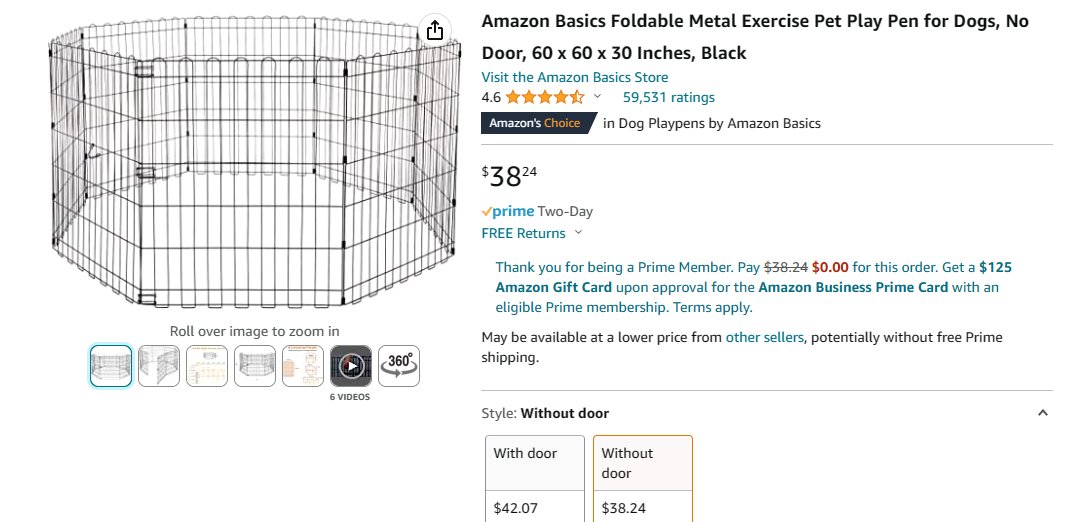
Amazon.com : puppy exercise pen
exercise pens - Free shipping | Chewy
Also can be found at local stores like Wal-Mart, Tractor Supply, etc.
Consider getting an exercise pen for your yard if you don't have
a fenced-in yard (minimum 24" tall for short-term use, 30" will work for
longer), OR to serve as your "potty spot" in your fenced yard. I got two pens
like the above pen to attach for one larger pen (you don't need a door if you
can step over the height) to make a safe area for the puppy to be off leash in.
Advantage: they can play in here safely. Disadvantage: they will potty in the
play area. BUT, you can easily move the fence after a stool so they can continue
playing without stepping in the stool, as they usually poo right at the edge of
the fence. The pen is light and easily moved, which is also handy when mowing
the yard.
DON'T PRAISE DURING
POTTYING...ONLY WHEN COMPLETELY FINISHED If you begin praising
the puppy for pottying WHILE he/she is pottying, you may interrupt the
concentration so he/she doesn't completely void. Then, a potty accident will
quickly happen when you return inside.
STAND STILL OUTSIDE, OR MOVE AROUND? When I'm outside with a puppy that I want to go potty, I stand completely
still (unless that doesn't work after a week or two, and then I might try
slow walking). Sometimes, the puppies will come to me and want me to pick
them up, but I ignore them if it's potty time. If I walk around, they seem more interested in
moving with me and are not looking for a place to go. I also stand in the same
place every time, so they go potty in the same area every time. Each time
they go outside, they can smell their previous potties there, which I think
also helps them prepare to go. When we play outside, I go to a different
place (away from the potty area) to play for both cleanliness reasons and
also to keep play and potty separate. Many people/trainers even suggest
taking soiled paper towels (pee) and stools from indoor accidents outside
and placing them at the potty location in the yard.
POTTYING INDOORS AFTER BEING OUTSIDE...FRUSTRATING.
TIPS FOR HELP! Young puppies often go
outside, don't go potty, and then return to the house and potty within a few
minutes. Or, they will pee outside a little, go back to the house, and
within a couple minutes will pee more (this often happens if we praise them
before they are finished pottying, which interrupts them so they aren't
finished...it's best to not praise them or move until they are
totally finished). It is normal, because sometimes they really
don't have to go to the bathroom when we take them out. As they learn the
potty training process, they learn to "try" longer when they go outside, but it's
too early for that in the beginning.
POTTYING IN THE CRATE? Pottying in the crate isn't unusual at first, as puppies can't "hold it" for
very long. But, having a too-large crate does give the puppy the idea that
he can use part of the crate for a bathroom, and have a part for sleeping. Blocking off part of the crate
to make it JUST large enough for the bed may be
a good idea until the puppy is better potty trained. If a puppy continually pees in
the crate, a drastic measure might need to be taken: leave the wet towel in
the crate and don't use a bed. Quickly, the puppy will discover that you are
no longer constantly refreshing the bed, and he will try to hold it to avoid having to
live in his potty.
EARLY START AT THEIR BIRTHPLACE:
We have had puppies leave us that have been going to the door
and whining or ringing a bell within 3 days of leaving for their new homes. That
is not the norm, but it does indicate some people make great strides very fast.
That takes some great watch skills and dedication, but shows that puppies are
definitely trainable with diligent owners. You can do this! You can succeed,
too!
Many people raise puppies in a small area with
papers on the floor, and the puppies learn to poo/pee in the same place that
they eat/sleep. Instead of that, we have an eating/sleeping kennel, with a doggie door to an
outside area. "Almost 100%" of our puppies are going outside to potty 100% of the time
before they are 7 weeks old (through their doggie doors), so they already have a
desire to stay clean and potty outside. It's up to us humans to continue that
desire with training to get them going outside.
GREAT LINKS BELOW! I could write a long article (or a short and to-the-point one)
about potty training, but why reinvent the wheel? There are some fantastic
references online that have already done a thorough job.
If you know of another superb link to add that would help puppy
owners, please let us know so we can add it here.
Because potty training and general obedience training benefit
each other, the links below cover more than just house training.
Training Links
Potty/House Training
General Training
Biting and Dominance
Crate Training
Chewing
Shows and Grooming
Top
Potty Training (Housetraining)
The potty training is the toughest thing for me, also. So much of it is
"timing," so we start by taking the puppy outside as soon as he/she wakes up
from a nap, and also within 20 minutes of eating if he hasn't shown signs of
wanting to go after eating.
We can usually tell if a puppy has to (I guess I have to say this
word...unavoidable, LOL!) poop. ;-) When they need to go, their bottom/anus
will be puffing out a little bit. If it isn't puffing out, "usually," they
aren't close enough to needing to potty to be able to get them to go at this
age. You'll quickly learn to recognize that physical sign, and also his
signs of looking for a place to go.
We like to take them to the door, set them on the floor, and either tap
their paw on the door or ring a bell (hanging from a string or a bell that
is suctioned to the floor) before proceeding outside. This teaches them that
they need to "give a sign" at the door to signify that they need to go
outside. If we pick them up and carry outside, without stopping and asking
them to make a signal, it may take longer to get them to give us a sign.
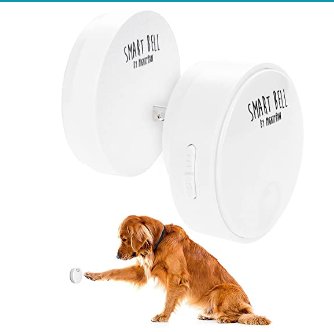
Dog potty bells on Amazon
Dog potty bells on
Chewy
(Don't get the paw-shaped one...the round/square/rectangles are much
easier for puppies to use)
General Training
3
0 Days to Puppy
Perfection, online course:
30 Days to Puppy Perfection - How to Train A Dream Dog
All Training Topics...very nice site!
http://www.canismajor.com/dog/ttrain.html
Puppy Training Tips
http://www.perfectpaws.com/pup17.html
Puppy Training Rules
http://www.peteducation.com/article.cfm?cls=2&cat=1549&articleid=173
Miscellaneous tips
http://p4.hostingprod.com/@quietwinterfarm.org/House_breaking_101.html
Video clips for common
"tricks"
http://www.ehow.com/videos-on_1381_train-beagle.html
Commands/Vocabulary/Common
Words used for training
Online/Remote Training Classes can be REALLY
HELPFUL! Search online for "online puppy training class" or similar
key words.
Here are some example results...I have not taken all of these
courses, so am not indicating that they are tested by me/us.
I'm just sharing some search results with you.
Puppy Starter Classes https://www.howtotrainadreamdog.com/puppy-training-classes/
https://www.akc.org/expert-advice/training/online-training-a-new-resource-for-dog-owners/
(info, and a few links to training)
https://www.thesprucepets.com/best-online-dog-training-courses-5075564
https://www.howtotrainadreamdog.com/ Online training (MANY
FREE VIDEOS), YouTube
videos, Zoom meeting options (free and also paid-for training)
https://www.petco.com/shop/en/petcostore/c/online-dog-training-courses
https://spiritdogtraining.com/online-dog-training/
Zak George's Dog Training Revolution, New Puppy Channel:
Zak's Puppy Youtube Channel/Video List
Kikopup Youtube Channel:
Dog
Training by Kikopup - YouTube
Some of the above are FREE.
Paid online training courses
are probably even better, though.
The free online "courses" typically tell you "what to teach them to do," but
not always HOW to teach them those things.
Through searching and reading lots of blogs and watching
lots of videos, you CAN piece together those teaching tips. Or, you can pay
for a course, and find out HOW to train a lot more easily than piecing it
together by yourself. Examples:
30 Days to Puppy Perfection
https://www.howtotrainadreamdog.com/puppy-perfection-course/
https://www.puppytrainedright.com/site/home
Biting and Dominance
Puppies need structure and rules. Without structure and rules, they feel lost
and out of control. They may then act in ways that seem like they are going to
be "bad dogs." But, structure and showing puppies what is and isn't appropriate
behavior can guide them to becoming the best dog you could ever hope for!
The first article seems to work well for us, and is quite different from most of
the other articles. It is based upon acting the way another adult dog would act
in response to puppy aggression. Some people don't recommend it, but it really
can work quickly to stop aggressive biting in young puppies.
Teach the puppy that you are alpha over her (the first link)
Teach the puppy that you don't like being bitten, and you won't play after she
bites (stopping play with a "time out")
Make biting unpleasant without punishing (pushing fingers FARTHER into mouth
when biting occurs...some trainers love this, some disapprove)
Using play time to train puppy to do tricks until the biting stage is over.
You may only need to do one of these, or you might try several/all tips at one
time until her biting phase is over.
ideo from How to
Train a Dream Dog:
https://www.youtube.com/watch?v=bn1nGZ9MgzQ&feature=youtu.be
How to combat puppy biting:
http://www.canismajor.com/dog/bite2.html (using a method you would see another
dog use toward a biting puppy)
Rules and structure...the setup for behavior expectations:
https://www.brilliantfamilydog.com/blog/10-ways-to-stop-puppy-biting
Caesar's tips:
https://www.cesarsway.com/dog-behavior/biting/nipping-nipping-in-the-bud
Simple explanation and tips:
https://pets.webmd.com/dogs/guide/biting-puppy-how-train-puppy-bites (I like
this from this article: "Avoid jerking your hands or feet away from your puppy
when he mouths. This will encourage him to jump forward and grab at you. It’s
much more effective to let your hands or feet go limp so that they aren’t much
fun to play with."
Taking that a step further, I know some people have had success very quickly
with sticking their fingers INTO puppies mouths during biting...like you are
trying to push a pill down the back of the puppy's throat. Puppies don't like
that, and soon learn that they don't want to bite because you'll make it
unpleasant.
AKC's tips:
https://www.akc.org/expert-advice/training/puppy-training/how-prevent-puppy-biting/
I also like that there is a popup on this page where you can insert your
puppy's birthday, and AKC will send you tips for timely advice based upon your
puppy's age.
More reinforcement about "biting results in me not interacting
with you!"
https://www.preventivevet.com/dogs/how-to-stop-puppy-nipping-and-biting
Simple tips to stop biting:
http://www.dogbreedinfo.com/puppybiting.htm
Training! Making play time "training time" to keep your puppy
busy can engage his brain in a good way while he goes through the biting stage!
51 Puppy Tricks (a book with simple tricks to teach your puppy, making
for constructive and fun play while redirecting puppy away from biting)
Reducing "doggie dominance"
http://www.inch.com/~dogs/taming.html
Crate Training
Chewing
Training (and Grooming)
for Shows
Potty/House Training
General Training
Biting and Dominance
Crate Training
Chewing
Shows and Grooming
Top